
Paver Patio Cost in Naples FL (2026 Pricing Guide)
Last Updated: March 26, 2026
How much should a paver patio cost in Naples?
Typical Cost Range for Paver Patios in Naples
Price Range: $12 - $32 per square foot
- basic installations with favorable conditions
- complex, high-end projects with significant prep work
Major Factors That Affect Paver Patio Cost:
Project size
Site conditions
Project complexity
Quality + peace of mind
We’ll go through each one and show how they shift pricing.
Project Size
As square footage increases, price per square foot typically decreases.
This is because:
- fixed costs are spread across more square footage
- setup and mobilization represent a smaller portion of the total project
- material pricing tends to improve at higher volumes
We’ve installed paver patios from over 10,000 square feet to as small as under 100 square feet, but the average patio in the Naples area is roughly between 300-500 square feet, and we’ll use that approximate sizing for most of our pricing examples.
Project Size Comparison Examples
Assuming identical conditions:
- Little to no demolition
- Good soil conditions
- Simple design and layout
- Patio only
You might see pricing like:
👉 100 square foot patio: ~$20-30/sf
👉 500 square foot patio: ~$14-17/sf
👉 1000 square foot patio: ~$13-15/sf
Patio Extensions
Patio extensions are usually small projects, and therefore often more expensive per square foot.
Even though the scope is smaller, they still require:
- crew mobilization
- base prep
- edge restraints
- finishing work
So the price doesn’t scale down proportionally.
Pricing for typical small patio extensions (100 square feet or less) will often be $20 per square foot or more, with the average price per square foot increasing as the extension square footage gets smaller.
For example, an extension of just 120 square feet could easily cost $30 per square foot.
Site Conditions
Site conditions are one of the biggest hidden cost drivers, and often the hardest to estimate without seeing the property.
Key Site Condition Factors
- Soil conditions
- Tree roots and other obstructions
- Drainage issues
- Existing surfaces
- Ease of access
Soil Conditions
Soft or unstable soils may require deeper excavation and additional base material to create a stable foundation.
In Naples, sandy soil is common, but conditions can still vary from property to property. In some cases, additional compaction or thicker base layers are needed to prevent shifting, settling, or uneven pavers over time.
Tree Roots, Wiring, Plumbing, and Other Obstructions
Tree roots, irrigation lines, plumbing, or buried utilities can slow down installation and require adjustments during the project.
These obstructions often need to be carefully worked around, relocated, or in some cases removed entirely. This adds labor time and can introduce additional coordination if other trades are involved.
Drainage Issues
Poor drainage may require regrading or additional solutions to prevent long-term problems.
If water is not properly directed away from the patio and home, it can lead to erosion, settling, or premature failure. Addressing drainage during installation is critical, and doing it correctly can add both time and cost upfront.
Existing Surface
Removing an existing surface is often one of the largest cost variables in a project.
Concrete removal is significantly more labor-intensive than removing pavers or working on bare ground, and it typically requires heavier equipment, disposal costs, and additional time.
Ease of Access
Another big factor that affects cost is ease of access – that is, how easy or challenging it is to move materials in and out of the project area.
This is often a factor in patio projects because they are typically located in backyards where a truck with materials and large equipment cannot easily pull up to because of fencing and tight spaces.
Project Complexity
Complexity affects how much time, precision, and labor the project requires.
Common Project Complexity Factors
- Premium layouts
- Curves and non-linear edges
- Additional paver structures
- Integration with other, non-paver, elements
Premium layouts
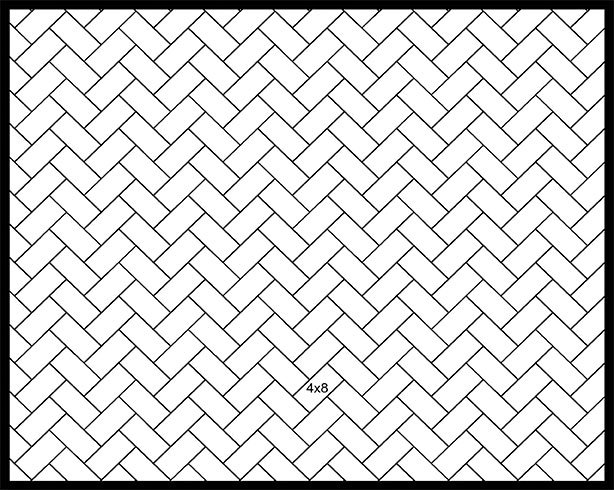
More complex designs require more labor, particularly for precisely cutting pavers.
One common design that will cost more is a 45 degree herringbone design, pictured below.
Curves and Non-Linear Edges
Curves can add cost for the same reason as premium layouts – additional cuts. Straight edges are your friend if you’re very budget conscious, but if you are looking for a more premium feel, curves are one way to go.
Additional paver structures
Features like borders, transitions, or decorative inlays add time and precision to the installation process, increasing both labor and material costs.
Adjacent/attached paver structures are also a factor, like walkways, planters, or steps.
Additional Non-Paver Elements
Additional elements are things that are not part of the paver surface, such as planters, landscaping, lighting, water features, other hardscape elements, and more.
These additional elements are beyond the scope of this guide as there are simply too many possibilities to cover, but we can still give a rough range estimate for a few minor additional items.
Quality and Peace of Mind
The biggest differences in price usually come from what happens beneath the surface.
This is also the hardest part of a project for a homeowner to evaluate — because most of it isn’t visible once the patio is complete.
What's Really Different Between Companies
- Installation quality
- Quality of materials
- Reliability
- Warranty
Installation quality
This refers to how closely the installation follows best practices — which directly impacts how long the patio lasts.
- Proper excavation depth
- Correct base thickness
- Compaction in the appropriate number of layers
- Proper slope and drainage
This is a major part of what determines whether your patio lasts 5 years or 25 years.
Material Quality
This is about the quality of the materials used.
There is not typically a wide range of quality in base material, as long as an appropriate base material is used (crushed limestone or DOT road base).
There is a wider range of quality in the sand that is used, as well as the edging.
- Base material (typically similar across companies)
- Sand quality (can vary significantly)
- Edge restraints (critical for longevity)
Reliability
This refers to the company’s responsiveness to you from when you initially reach out, to during the project, to long after your installation is complete in the event that you reach out about a problem.
This is one of the areas that companies commonly cut corners.
- Communication before the project
- Professionalism during installation
- Willingness to address issues after completion
This is one of the most overlooked – and most important – differences.
Warranty
The existence of a warranty, and how long and comprehensive that warranty is.
The most common warranty for new installations is 1 year, with some companies offering up to 3 years.
The longer and more comprehensive the warranty, the more peace of mind.
A longer warranty often reflects:
- higher confidence in installation quality
- willingness to stand behind the work
Real-World Pricing Examples: Three 500 sq ft Paver Patios with Different Conditions
To isolate the impact of different factors, all examples below assume a patio size of 500 square feet.
Example 1 – Standard Installation (Most Common Scenario)
A typical paver patio installation with minimal complications.
Key factors:
- Good soil conditions
- Simple design & layout
- Standard-quality installation
- No demolition
Reasonable Range: $12-$15 per square foot
Example 2 – Demo + Difficult Access
Costs increase due to both demolition and difficult access.
Key factors:
- Concrete demolition and removal
- High-quality installation practices
- Access challenges
Reasonable Range: $15-$20 per square foot
Example 3 – Complex Design + Demo + Difficult Access
Even beyond site challenges, complex designs add additional cost due to increased labor and precision.
Key factors:
- Demolition required
- Difficult access
- Complex layout (patterns, borders, or curves)
- High attention to detail
- Premium installation approach
Reasonable Range: $17-$25 per square foot
Find out exactly what your paver patio will cost
Every project is unique – and the only way to get an exact number is to evaluate your specific property and project.
That said, by now you should have a solid understanding of:
- what drives pricing
- what’s reasonable
- what to watch out for
👉 Request a free, no-obligation estimate by clicking the button below:
Check out our other pricing guides
Table of Contents
(click the arrow to show/hide)
▼Recent Reviews
"Managed a very large project professionally and with panache. Much love"
Get a Free Estimate
You will hear back by phone within 24 hours
"*" indicates required fields
We will never sell or share your information